| Manufacturer | \nBaader Planetarium | \n
|---|---|
| Net weight (kg) | \n0.07 | \n
| Colour | \nBlack | \n
| Transmission Range | \nH-alpha | \n
| Filter Thickness (without cell) | \n2 mm | \n
| HBW (Half bandwidth) | \n3.5 nm | \n
| CWL (Central Wavelength) | \n656,3 nm | \n
| AR-Coating | \nReflex-Blocker™ hard coated, Plane-optically polished | \n
| Special Features | \nCMOS-optimized with Life-Coat™\n | \n
| Filter Usage | \nCMOS, CCD, H-alpha | \n
| Type of Filter | \nf/2 Ultra-High-speed | \n
| Single or Set? | \nSingle Filter | \n

Original: $215.54
-65%$215.54
$75.44The Story
Highlights
- 2" x 2 mm Baader CMOS H-alpha f/2 Ultra-High-speed Filter – Premium Grade – with 2" (M48) filter thread
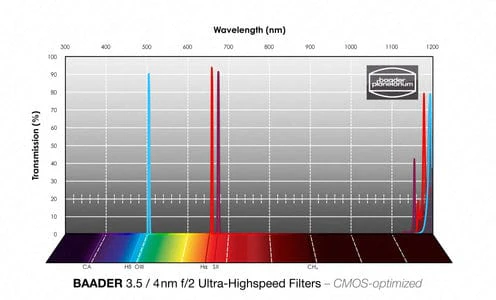
- 3.5 nm FWHM (to harmonize the exposure time with O-III / S-II), recommended for extremely fast optical systems from f/3.4 to f/1.8
- Specially designed for the special filter requirements when used with fast optics like the Celestron RASA astrographs
- For highest contrast even at strongest light pollution, minimizes star size, emphasizes finest nebula detail – indispensable under Bortle 9/8/7/(6) skies
- Reflex-Blocker™ hard coated and Plane-optically polished – with sealed coating edges (Life-Coat™)
- Blackened edges all around, with filter-lead-side-indicator in the form of a telescope-sided black outer rim
- Optimized for modern CMOS cameras, but likewise excellent for CCD camera technologies
- Mounted in Baader Low Profile Filter Cell (LPFC) – 6 mm height
This new generation of Baader CMOS-filters features:


DON´T BE MISLED.
These all new CMOS-optimized filters work magnificently with all existing digital camera technologies, be it CMOS or CCD. However – an owner of CCD-camera-technology will still find our previous, extremely affordable, narrowband filter technology to be fully apt for excellent imaging. But: "the Better always is enemy to the Good".
FAQ
-
Unmounted Filters – which side should face the telescope?
For our CMOS-optimized filters we have created the following images showing which side of the filter should face the telescope.

LEGACY FAQ for older unmounted CCD-Filters without black outer rim
Question in Detail:
I just bought LRGB 36mm unmounted filters. I have question: which side of filter should be placed towards telescope? Is it better way of distinguish than "more shiny surface towards telescope"?
Answer:
 Always put the more reflective side towards the telescope side. To guide you we already put a small arrow on the filter rim, on those filters were the position matters. This arrow indicates which face of the filter should be directed towards the sky (telescope-sided). All cell-mounted filters are already oriented in a way that the most appropriate filter face is facing the sky when the filter would be mounted directly onto the front end of the nosepiece of a camera.
If you mount your filter the other way, any reflected light would have a short way to the camera sensor, resulting in a higher risk of getting some kind of back-reflections inside the camera field. Many sensors have highly reflective areas near to the light sensitive area, also the area with the bonding contacts is sometimes highly reflective.But: this is true only for instruments without optical elements near to the focal plane. If you have f.e. a coma corrector, field flattener, focal reducer, focal extender (to a lower degree due to concave surface), or in extreme cases a whole lens group for more complex field corrections a few centimeters in front of the filter it could be useful to flip the filter against the rule from above (thus having the arrow pointing away from the telescope). Cause in such cases the likelihood of reflections from the sensor could be lesser then fort- and back- reflections from such glass-surfaces. If in doubt, it helps to make some test images from a star field with bright stars, using the filter in both ways for comparison.
Should you really have some reflections with both positions it can be more effective to add a spacer between filter and camera, eventually shifting the reflection out of the image field. With focal correctors having curved surfaces changing the filter-lens distance could help also.
-
HALOS – viewed without prejudice
For our CMOS-optimized filters we have created the following images showing which side of the filter should face the telescope.
LEGACY FAQ for older unmounted CCD-Filters without black outer rim
Question in Detail:
I just bought LRGB 36mm unmounted filters. I have question: which side of filter should be placed towards telescope? Is it better way of distinguish than "more shiny surface towards telescope"?
Answer:
Always put the more reflective side towards the telescope side. To guide you we already put a small arrow on the filter rim, on those filters were the position matters. This arrow indicates which face of the filter should be directed towards the sky (telescope-sided). All cell-mounted filters are already oriented in a way that the most appropriate filter face is facing the sky when the filter would be mounted directly onto the front end of the nosepiece of a camera.
If you mount your filter the other way, any reflected light would have a short way to the camera sensor, resulting in a higher risk of getting some kind of back-reflections inside the camera field. Many sensors have highly reflective areas near to the light sensitive area, also the area with the bonding contacts is sometimes highly reflective.But: this is true only for instruments without optical elements near to the focal plane. If you have f.e. a coma corrector, field flattener, focal reducer, focal extender (to a lower degree due to concave surface), or in extreme cases a whole lens group for more complex field corrections a few centimeters in front of the filter it could be useful to flip the filter against the rule from above (thus having the arrow pointing away from the telescope). Cause in such cases the likelihood of reflections from the sensor could be lesser then fort- and back- reflections from such glass-surfaces. If in doubt, it helps to make some test images from a star field with bright stars, using the filter in both ways for comparison.
Should you really have some reflections with both positions it can be more effective to add a spacer between filter and camera, eventually shifting the reflection out of the image field. With focal correctors having curved surfaces changing the filter-lens distance could help also.
-
Off-standard single filter sizes from Baader - why not:
Quite often we receive requests for a single filter in an off-standard size. In all cases we are sorry that we must answer as follows:
Sorry (we know it would be so very much cheaper in production - and we would be so much more flexible to fill special requests) - but we have decided long ago to not cut or saw our filters from large plates because this would leave the coating stack open and mutilated (with microscopic cracks) all around, prone to aging and peeling.
Many times we had the chance to inspect our competitors filters after several years of use (due to our 30+years of servicing SBIG-CCD-cameras/and filter wheels) and we realized already 15 years ago how moisture and heat stress can deteriorate even most modern hard coatings, slowly peeling off from the carrying substrate over time, unless the coating stack is sealed all around the filter stack.
As a consequence - in order to create our filters to remain impermeable - we only offer all filter substrates already cut to final shape and run each substrate on an double deck auto-polisher to achieve perfect optical flatness and freedom from cone errors.
Then we do individually coat these substrates in 500 pc per run as minimum to fill a complete coating chamber, in a way that the coating stack (many times 50+ layers) applied onto each filter won't reach to the very edge of the round or square substrate, so that the coating stack remains completely sealed from all sides. In this way we can ensure that our filters will not age at all.The sad effect is that we cannot offer other sizes unless the inquired production quantity were in the range of 250 to 500 pc (depending on size) and the tooling rings or square holders will be paid for, which serve to precisely center each individual filter substrate within the rotating calotte inside the coating chamber. Sorry - as explained above - we just will not coat onto large plates and cut any shape from them, also because such large plates cannot be polished optically flat in the same way we do it.
For your most urgent need and for single piece solutions we can only recommend to order the next larger size of our respective filter and have that cut to shape by an ophthalmologist locally. We can supply the round filters without the metal cell in such cases; square filters come without cell in any case.

Specifications
| Manufacturer | Baader Planetarium |
|---|---|
| Net weight (kg) | 0.07 |
| Colour | Black |
| Transmission Range | H-alpha |
| Filter Thickness (without cell) | 2 mm |
| HBW (Half bandwidth) | 3.5 nm |
| CWL (Central Wavelength) | 656,3 nm |
| AR-Coating | Reflex-Blocker™ hard coated, Plane-optically polished |
| Special Features | CMOS-optimized with Life-Coat™ |
| Filter Usage | CMOS, CCD, H-alpha |
| Type of Filter | f/2 Ultra-High-speed |
| Single or Set? | Single Filter |
Details & Craftsmanship
Every detail has been carefully considered to bring you the perfect product.

Details & Craftsmanship
Every detail has been carefully considered to bring you the perfect product.

Details & Craftsmanship
Every detail has been carefully considered to bring you the perfect product.

Details & Craftsmanship
Every detail has been carefully considered to bring you the perfect product.

Details & Craftsmanship
Every detail has been carefully considered to bring you the perfect product.

Details & Craftsmanship
Every detail has been carefully considered to bring you the perfect product.

Details & Craftsmanship
Every detail has been carefully considered to bring you the perfect product.

Details & Craftsmanship
Every detail has been carefully considered to bring you the perfect product.

Details & Craftsmanship
Every detail has been carefully considered to bring you the perfect product.

Details & Craftsmanship
Every detail has been carefully considered to bring you the perfect product.

Details & Craftsmanship
Every detail has been carefully considered to bring you the perfect product.

Details & Craftsmanship
Every detail has been carefully considered to bring you the perfect product.

Details & Craftsmanship
Every detail has been carefully considered to bring you the perfect product.

Details & Craftsmanship
Every detail has been carefully considered to bring you the perfect product.

Details & Craftsmanship
Every detail has been carefully considered to bring you the perfect product.

Details & Craftsmanship
Every detail has been carefully considered to bring you the perfect product.

Details & Craftsmanship
Every detail has been carefully considered to bring you the perfect product.

Details & Craftsmanship
Every detail has been carefully considered to bring you the perfect product.

Details & Craftsmanship
Every detail has been carefully considered to bring you the perfect product.

Details & Craftsmanship
Every detail has been carefully considered to bring you the perfect product.

Details & Craftsmanship
Every detail has been carefully considered to bring you the perfect product.

Details & Craftsmanship
Every detail has been carefully considered to bring you the perfect product.

Details & Craftsmanship
Every detail has been carefully considered to bring you the perfect product.

Details & Craftsmanship
Every detail has been carefully considered to bring you the perfect product.

Details & Craftsmanship
Every detail has been carefully considered to bring you the perfect product.

Details & Craftsmanship
Every detail has been carefully considered to bring you the perfect product.

Details & Craftsmanship
Every detail has been carefully considered to bring you the perfect product.

Details & Craftsmanship
Every detail has been carefully considered to bring you the perfect product.

Details & Craftsmanship
Every detail has been carefully considered to bring you the perfect product.

Details & Craftsmanship
Every detail has been carefully considered to bring you the perfect product.

Details & Craftsmanship
Every detail has been carefully considered to bring you the perfect product.

Details & Craftsmanship
Every detail has been carefully considered to bring you the perfect product.

Details & Craftsmanship
Every detail has been carefully considered to bring you the perfect product.

Details & Craftsmanship
Every detail has been carefully considered to bring you the perfect product.

Details & Craftsmanship
Every detail has been carefully considered to bring you the perfect product.

Details & Craftsmanship
Every detail has been carefully considered to bring you the perfect product.
Description
Highlights
- 2" x 2 mm Baader CMOS H-alpha f/2 Ultra-High-speed Filter – Premium Grade – with 2" (M48) filter thread
- 3.5 nm FWHM (to harmonize the exposure time with O-III / S-II), recommended for extremely fast optical systems from f/3.4 to f/1.8
- Specially designed for the special filter requirements when used with fast optics like the Celestron RASA astrographs
- For highest contrast even at strongest light pollution, minimizes star size, emphasizes finest nebula detail – indispensable under Bortle 9/8/7/(6) skies
- Reflex-Blocker™ hard coated and Plane-optically polished – with sealed coating edges (Life-Coat™)
- Blackened edges all around, with filter-lead-side-indicator in the form of a telescope-sided black outer rim
- Optimized for modern CMOS cameras, but likewise excellent for CCD camera technologies
- Mounted in Baader Low Profile Filter Cell (LPFC) – 6 mm height
This new generation of Baader CMOS-filters features:
DON´T BE MISLED.
These all new CMOS-optimized filters work magnificently with all existing digital camera technologies, be it CMOS or CCD. However – an owner of CCD-camera-technology will still find our previous, extremely affordable, narrowband filter technology to be fully apt for excellent imaging. But: "the Better always is enemy to the Good".
FAQ
-
Unmounted Filters – which side should face the telescope?
For our CMOS-optimized filters we have created the following images showing which side of the filter should face the telescope.
LEGACY FAQ for older unmounted CCD-Filters without black outer rim
Question in Detail:
I just bought LRGB 36mm unmounted filters. I have question: which side of filter should be placed towards telescope? Is it better way of distinguish than "more shiny surface towards telescope"?
Answer:
Always put the more reflective side towards the telescope side. To guide you we already put a small arrow on the filter rim, on those filters were the position matters. This arrow indicates which face of the filter should be directed towards the sky (telescope-sided). All cell-mounted filters are already oriented in a way that the most appropriate filter face is facing the sky when the filter would be mounted directly onto the front end of the nosepiece of a camera.
If you mount your filter the other way, any reflected light would have a short way to the camera sensor, resulting in a higher risk of getting some kind of back-reflections inside the camera field. Many sensors have highly reflective areas near to the light sensitive area, also the area with the bonding contacts is sometimes highly reflective.But: this is true only for instruments without optical elements near to the focal plane. If you have f.e. a coma corrector, field flattener, focal reducer, focal extender (to a lower degree due to concave surface), or in extreme cases a whole lens group for more complex field corrections a few centimeters in front of the filter it could be useful to flip the filter against the rule from above (thus having the arrow pointing away from the telescope). Cause in such cases the likelihood of reflections from the sensor could be lesser then fort- and back- reflections from such glass-surfaces. If in doubt, it helps to make some test images from a star field with bright stars, using the filter in both ways for comparison.
Should you really have some reflections with both positions it can be more effective to add a spacer between filter and camera, eventually shifting the reflection out of the image field. With focal correctors having curved surfaces changing the filter-lens distance could help also.
-
HALOS – viewed without prejudice
For our CMOS-optimized filters we have created the following images showing which side of the filter should face the telescope.
LEGACY FAQ for older unmounted CCD-Filters without black outer rim
Question in Detail:
I just bought LRGB 36mm unmounted filters. I have question: which side of filter should be placed towards telescope? Is it better way of distinguish than "more shiny surface towards telescope"?
Answer:
Always put the more reflective side towards the telescope side. To guide you we already put a small arrow on the filter rim, on those filters were the position matters. This arrow indicates which face of the filter should be directed towards the sky (telescope-sided). All cell-mounted filters are already oriented in a way that the most appropriate filter face is facing the sky when the filter would be mounted directly onto the front end of the nosepiece of a camera.
If you mount your filter the other way, any reflected light would have a short way to the camera sensor, resulting in a higher risk of getting some kind of back-reflections inside the camera field. Many sensors have highly reflective areas near to the light sensitive area, also the area with the bonding contacts is sometimes highly reflective.But: this is true only for instruments without optical elements near to the focal plane. If you have f.e. a coma corrector, field flattener, focal reducer, focal extender (to a lower degree due to concave surface), or in extreme cases a whole lens group for more complex field corrections a few centimeters in front of the filter it could be useful to flip the filter against the rule from above (thus having the arrow pointing away from the telescope). Cause in such cases the likelihood of reflections from the sensor could be lesser then fort- and back- reflections from such glass-surfaces. If in doubt, it helps to make some test images from a star field with bright stars, using the filter in both ways for comparison.
Should you really have some reflections with both positions it can be more effective to add a spacer between filter and camera, eventually shifting the reflection out of the image field. With focal correctors having curved surfaces changing the filter-lens distance could help also.
-
Off-standard single filter sizes from Baader - why not:
Quite often we receive requests for a single filter in an off-standard size. In all cases we are sorry that we must answer as follows:
Sorry (we know it would be so very much cheaper in production - and we would be so much more flexible to fill special requests) - but we have decided long ago to not cut or saw our filters from large plates because this would leave the coating stack open and mutilated (with microscopic cracks) all around, prone to aging and peeling.
Many times we had the chance to inspect our competitors filters after several years of use (due to our 30+years of servicing SBIG-CCD-cameras/and filter wheels) and we realized already 15 years ago how moisture and heat stress can deteriorate even most modern hard coatings, slowly peeling off from the carrying substrate over time, unless the coating stack is sealed all around the filter stack.
As a consequence - in order to create our filters to remain impermeable - we only offer all filter substrates already cut to final shape and run each substrate on an double deck auto-polisher to achieve perfect optical flatness and freedom from cone errors.
Then we do individually coat these substrates in 500 pc per run as minimum to fill a complete coating chamber, in a way that the coating stack (many times 50+ layers) applied onto each filter won't reach to the very edge of the round or square substrate, so that the coating stack remains completely sealed from all sides. In this way we can ensure that our filters will not age at all.The sad effect is that we cannot offer other sizes unless the inquired production quantity were in the range of 250 to 500 pc (depending on size) and the tooling rings or square holders will be paid for, which serve to precisely center each individual filter substrate within the rotating calotte inside the coating chamber. Sorry - as explained above - we just will not coat onto large plates and cut any shape from them, also because such large plates cannot be polished optically flat in the same way we do it.
For your most urgent need and for single piece solutions we can only recommend to order the next larger size of our respective filter and have that cut to shape by an ophthalmologist locally. We can supply the round filters without the metal cell in such cases; square filters come without cell in any case.
Specifications
| Manufacturer | Baader Planetarium |
|---|---|
| Net weight (kg) | 0.07 |
| Colour | Black |
| Transmission Range | H-alpha |
| Filter Thickness (without cell) | 2 mm |
| HBW (Half bandwidth) | 3.5 nm |
| CWL (Central Wavelength) | 656,3 nm |
| AR-Coating | Reflex-Blocker™ hard coated, Plane-optically polished |
| Special Features | CMOS-optimized with Life-Coat™ |
| Filter Usage | CMOS, CCD, H-alpha |
| Type of Filter | f/2 Ultra-High-speed |
| Single or Set? | Single Filter |